

 PA Media
A town council has voted to postpone choosing a contractor to kill weeds after it received complaints from members of the public.
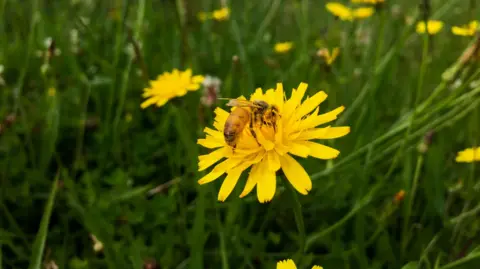
Penryn Town Council said weeds had been sprayed with glyphosate over the past few years, a herbicide which has been linked to cancer and a decline in bee populations.
Councillor Mael Garrec said 80 residents had asked the council to delay the vote and added using glyphosate “which kills bees to kill weeds is like using a sledgehammer to swat a fly”.
A spokesperson for the town council said “a decision on appointing a contractor was deferred to allow for other methods of removal to be investigated” and it was scheduled to take place on 5 January.

 PA Media
The spokesperson said the contractors which had submitted quotes for the works had suggested the use of glyphosate “as it appears to currently be the most cost effective and gives good results for the cost”.
Some countries have banned the use of glyphosate-based herbicide and some councils in England have stopped using it due to safety concerns.
Its effect on plants is non-selective, meaning it will kill most of them when applied in an area.
Around the UK various councils have moved away from using glyphosate-based herbicide.
Kevin Thomas is the spokesperson for Penryn Buzz, a group which promotes awareness of the importance of pollinators.
He pointed out that Wadebridge was one of the first local authorities in the UK to declare itself pesticide-free and had used methods including manual weeding and hot foam and steam treatments.
‘Dismayed’
Mr Thomas said: “Having achieved such positive results in our community over the last eight years we are dismayed to hear that Penryn Town Council is considering spraying glyphosate-based herbicide.
“We have deep concerns on the impact of its use both for the health of our local community and our environment,” he added.
He said the licence for glyphosate use by the Health and Safety Executive is set to expire in December 2026 while new scientific evidence was reviewed.
Mr Thomas concluded: “With the possibility that its use will be banned in the UK next year, exposing our community at this time is unacceptable.”
 Google Maps
Garrec said the council had spent time and money working with local environmental groups to boost the amount of flowers for pollinators and contracting the use of glyphosate was not consistent with those biodiversity aims.
In previous years Penryn Town Council has used Falmouth Town Council to fulfil the parks contract and glyphosate had been used, councillor Debra Clegg confirmed.
She said: “Falmouth Town Council uses glyphosate only in limited, targeted circumstances to keep pavements and highway edges in a safe, accessible condition.”
She said when the unitary authority had stopped routine weed control because of budget constraints, plants had grown out of pavements which “could pose hazards to pedestrians”.
She said the council’s policy was for trained staff to apply the herbicide using controlled-droplet applicators “ensuring minimal quantities, no drift and no blanket spraying”.
On alternative methods, Clegg said mechanical removal, flame-weeding, hot-foam systems and horticultural vinegar had been considered but had not been found to be feasible due to effectiveness and costs.
“Our approach balances the need to maintain safe and accessible public spaces with a commitment to minimising chemical use and supporting local biodiversity,” she added.